
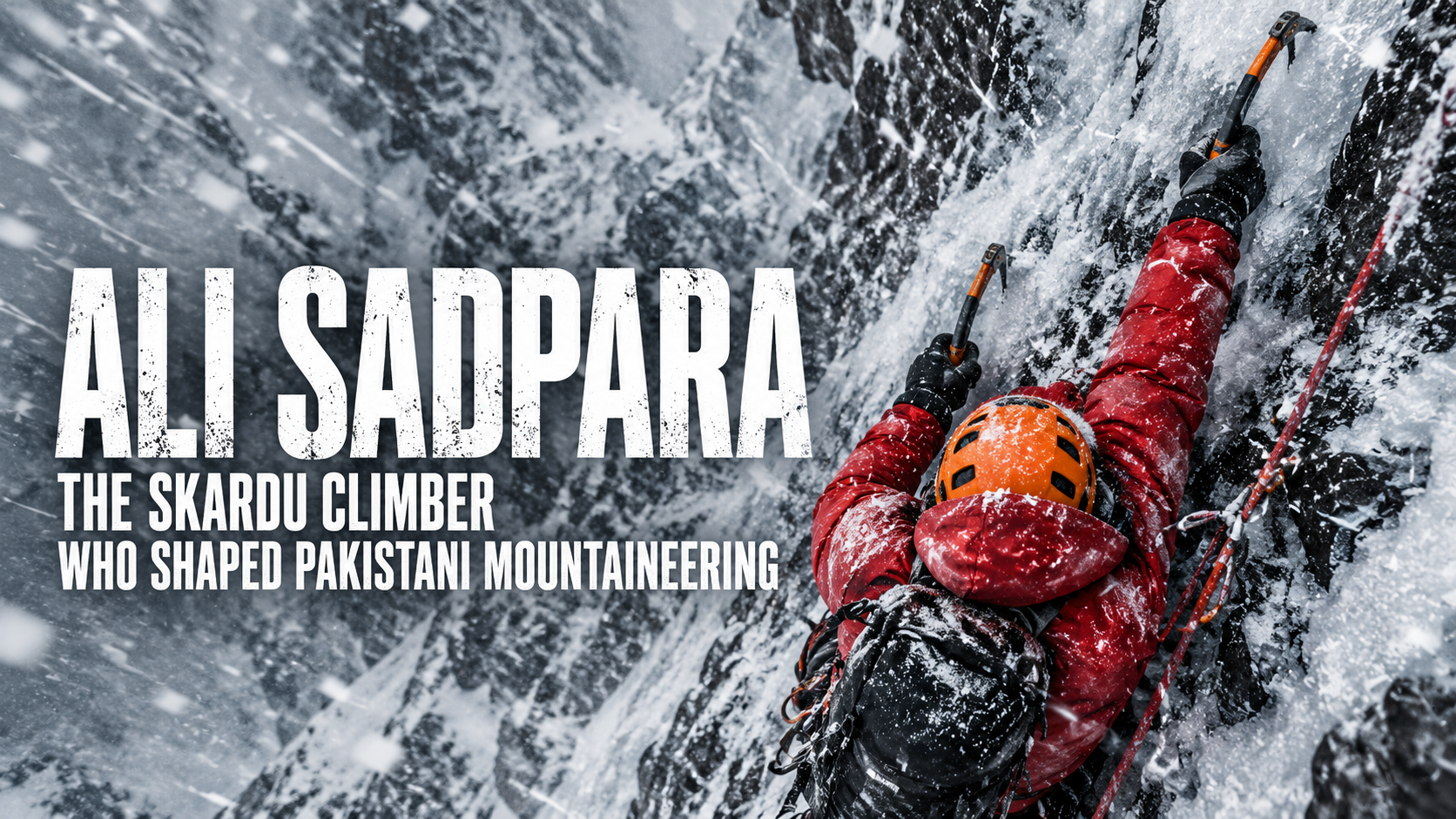
Ali Sadpara: The Skardu Climber Who Shaped Pakistani Mountaineering

Skardugo Editorial
October 26, 2026
If you visit Skardu and ask locals which name carries the most weight in mountaineering, you'll hear the same answer everywhere from the bazaar to the hotel guesthouses: Ali Sadpara. His full name was Muhammad Ali Sadpara, and the village he was born in — Sadpara, a few kilometres south of Skardu city — gave him both his surname and his first view of the Karakoram.
The 2026 Apple TV documentary The Last First: Winter K2 has introduced his story to a global audience. For those planning a trip to Skardu, understanding who he was adds a layer to the landscape that no tour brochure can provide.
A Porter Who Became Pakistan's Finest Climber
Ali Sadpara was born on February 2, 1976, in Sadpara village, Skardu. As a teenager and young man in the 1990s, he started the way many great Pakistani mountaineers did — as a high-altitude porter, carrying loads for international expeditions trekking to Baltoro Glacier and K2. The work is brutal at any altitude; above 6,000 metres it demands a physiology most people simply don't have.
He had it. Over two decades he moved from porter to high-altitude climber, eventually summiting eight of the world's 14 eight-thousanders — Gasherbrum II (2006), Gasherbrum I (2010), Nanga Parbat (multiple times), Broad Peak, K2, and others across Pakistan and Nepal. But the climb that set him apart from almost every other mountaineer alive came on February 26, 2016, when he stood on the summit of Nanga Parbat in winter — the first time anyone had done it. His partners that day were Alex Txikon and Simone Moro.
For context: Nanga Parbat at 8,126 metres is the world's ninth-highest peak and one of the most technically demanding winter objectives in the Himalaya. Reaching its top in conditions that regularly kill experienced climbers is the kind of achievement that earns a person a place in mountaineering's permanent record.
And yet when people in Skardu talk about him, they rarely lead with the list of summits. They talk about his simplicity — the fact that he kept living in Skardu, that he trained by running in the valleys around Satpara Lake, that he drove a regular car and coached younger climbers without charging them.
The Final Winter: K2, January–February 2021
By the winter of 2020–21, K2 was the only 8,000-metre peak never summited in winter — a gap that had resisted dozens of attempts over four decades. Ali Sadpara had tried it before. This time he organised a three-person independent team with Icelandic climber John Snorri Sigurjónsson and his son Sajid, who was 21 years old.
On January 16, 2021, a team of ten Nepali climbers — including Nirmal "Nims" Purja — made the first winter ascent of K2, completing one of the last unclaimed milestones in all of mountaineering. Three teams had joined forces to fix ropes and summit together. Ali Sadpara's team was not among them; they were preparing their own independent, oxygen-free attempt.
On the evening of February 4, Ali, John Snorri, and Chilean climber Juan Pablo Mohr Prieto left their highest camp for the summit. At the Bottleneck — a steep technical section at around 8,200 metres — Sajid's oxygen regulator failed. Ali told his son to descend. That was the last time Sajid saw his father.
The three men failed to return by the planned time on February 5. Sajid descended to base camp and coordinated search missions. Pakistan Army helicopters reached up to 7,000 metres but found nothing. On February 18, 2021, the three men were officially declared dead. In late July 2021, bodies were found near the Bottleneck area. Sajid Sadpara climbed K2 again that summer, found his father's remains, and buried him on the mountain.
What the Gilgit-Baltistan Government Promised
In the immediate aftermath, the Gilgit-Baltistan Tourism Minister announced several tributes: Skardu Airport would be renamed in Ali Sadpara's honour, a mountaineering school would be established bearing his name, his children would receive educational scholarships, and a civil award would be given to both Ali and Sajid Sadpara. Whether all of these have been fully implemented is a longer conversation — but the renaming proposal remains well known in Skardu and the wider GB community.
Sajid, for his part, has kept climbing. In July 2023 he led a team to clean a section of K2 as a tribute to his father. He was also present at the 2026 Sundance Film Festival for the premiere of The Last First: Winter K2.
Visiting Sadpara Village and the Area Around It
Sadpara village sits about 8 km south of Skardu's main bazaar, accessed by a paved road that curves around the western shore of Satpara Lake. The lake itself is a working reservoir feeding Skardu's power supply — don't expect a remote wilderness experience — but the surrounding landscape, framed by bare brown ridgelines and the odd patch of poplar trees, gives you an immediate sense of the terrain Ali Sadpara grew up watching.
The village is small and doesn't have tourist facilities, so treat a visit as a quiet drive rather than a destination with infrastructure. A more rewarding stop nearby is Satpara Lake itself, which is particularly striking in early morning light. From the lake road you can already see the high ridges of the Karakoram beginning to stack up to the north and east.
Back in Skardu, the Skardu Fort — Kharpocho — sits on a rock outcrop above the Indus and gives you a 360-degree view of the valley that puts the mountains in perspective. If you want to understand why Ali Sadpara's career moved upward the way it did, stand on that fort and look northeast. K2 is not visible from Skardu city, but the scale of the Karakoram's outer ridges makes the point plainly enough.
For a broader picture of the region — including the Baltit-era forts and the apricot valleys where many climbing families live — the Shigar Fort in Shigar Valley and the Khaplu Palace in Khaplu are both worth the drive. Several families of Pakistani high-altitude porters and climbers have roots in these valleys.
The Younger Generation
Ali Sadpara is survived by his wife Fatima, three sons (including Sajid), and a daughter. Sajid has described his plan to keep his father's mission alive, which includes completing a winter ascent of K2 without supplementary oxygen — the exact goal Ali died pursuing. Whether that attempt comes and what it costs is a story still being written.
For anyone heading to the Karakoram, either on a trekking permit for K2 Base Camp or just passing through Skardu on a valley tour, it's worth knowing that the mountains you're looking at have a human story attached — one that costs real families something every season.
Planning Your Skardu Trip
Skardu is accessible by a 55-minute PIA flight from Islamabad (roughly PKR 12,000–18,000 one way depending on season; book early as seats go fast in summer) or a 20–22 hour road journey via the Karakoram Highway through Gilgit. Flights cancel frequently due to visibility — always build a buffer day into your itinerary.
If you want to see the K2 story's setting up close without a full glacier trek, our 8-Day Skardu Valley Tour takes in Satpara Lake, Shigar, and Khaplu alongside Skardu's main sites. For those who want to walk toward K2 itself, our 14-Day K2 Base Camp Trek is the standard route, covering Askole to Concordia and on to base camp, with return via the same trail. Trekking season runs late June to early August; permits are required and arranged through licensed operators.
- Sadpara village: ~8 km from Skardu bazaar, no tourist facilities
- Satpara Lake: paved road access year-round, 30-minute drive from Skardu
- Skardu flights: Islamabad–Skardu, ~55 minutes, PKR 12,000–18,000
- K2 Base Camp trek season: late June to early August
- Best resource: The Last First: Winter K2 (Apple TV, released October 2, 2026) — watch it before you go
Ready for Your Adventure?
Let us handle the planning. Our expert-led tours offer an unforgettable experience of Skardu's wonders.
View Our Tour Packages