
Winter K2 2021: Ali Sadpara, Nimsdai & The Last First

Skardugo Editorial
October 26, 2026
Few chapters in mountaineering history hit as hard as the winter of 2020–21 on K2. Within three weeks, the world's second-highest peak delivered its only verified winter summit — and then swallowed three of the men who had dreamed of it longest. If you've just watched The Last First: Winter K2 on Apple TV and found yourself searching for Skardu on a map, this post is for you.
What Makes K2 in Winter Different
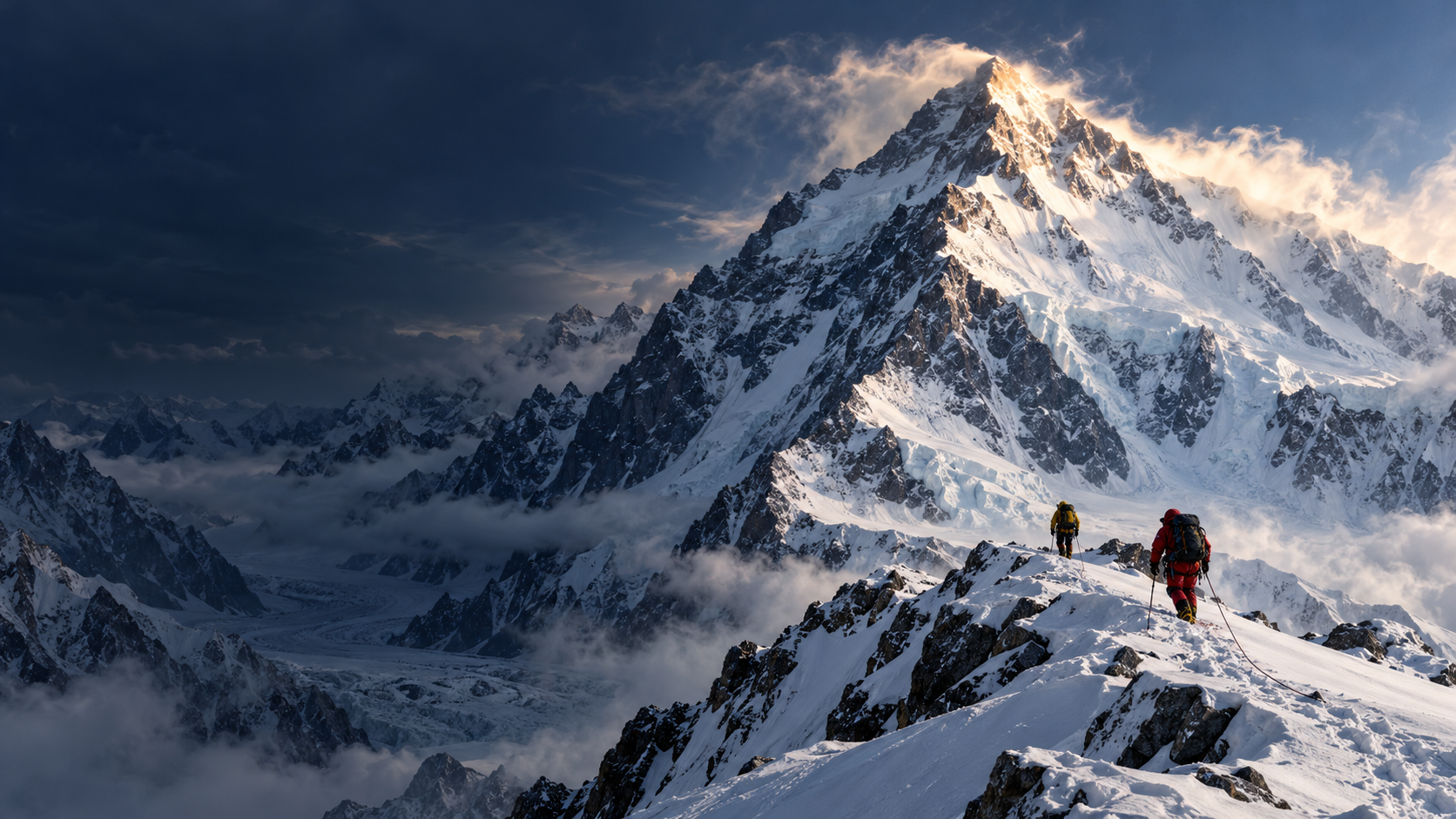
K2 sits at 8,611 metres in Pakistan's Karakoram range, roughly 160 km northeast of Skardu city. In summer, hundreds of climbers attempt it each season. In winter, jet-stream winds routinely exceed 200 km/h above 7,000 metres, temperatures drop below −60°C with wind chill, and daylight shrinks to around nine hours. Before January 2021, it was the only one of the world's 14 peaks above 8,000 metres that had never been climbed in winter — a gap that had stood for decades despite repeated attempts.
The 2020–21 winter season drew an unusual crowd. Alongside small independent teams came a 50-plus-person commercial outfit under Seven Summit Treks, a compact Nepali team led by Nirmal "Nims" Purja, a separate group under Mingma Gyalje (Mingma G) Sherpa, and a three-person independent team: Icelandic climber John Snorri Sigurjónsson, Pakistani high-altitude legend Muhammad Ali Sadpara, and his 21-year-old son Sajid.
January 16, 2021 — The Summit That Changed Everything
On January 16, 2021, at approximately 5 p.m. local time, ten Nepali climbers reached the summit of K2 together, completing the last unclimbed winter 8,000-metre peak. The ten were members of three separate expeditions — Nims Purja's team, Mingma G's team, and one additional climber — who had decided in the days prior to combine forces, jointly fix ropes on the upper mountain, and summit together. Among them, Nirmal Purja reached the top without supplementary oxygen, a detail that made an already historic day more remarkable.
The team waited at the summit and stepped onto the top together, an image that became one of the most shared in modern mountaineering. For Pakistan, the setting mattered as much as the climb: K2 is a Pakistani peak, located in Gilgit-Baltistan, and the base camp sits a multi-day trek from Askole village — itself accessed from Skardu.
February 4–5, 2021 — The Disappearance
Three weeks after the Nepali summit, Ali Sadpara, John Snorri, and Chilean climber Juan Pablo Mohr Prieto left their highest camp on the evening of February 4, intent on summiting without supplementary oxygen. At the Bottleneck — a steep, serac-threatened couloir at around 8,200 metres — Sajid Sadpara was forced to turn back after his oxygen regulator malfunctioned. His father told him to use spare oxygen from the emergency kit, but when that also failed, Ali Sadpara told Sajid to descend. That was the last time any of the three men were seen.
Sajid waited at Camp 3, then descended to base camp when the three did not return as planned. Pakistan Army helicopters flew search missions reaching up to 7,000 metres but found nothing. On February 18, 2021, the Pakistani government and Gilgit-Baltistan authorities officially declared all three men dead. In late July 2021, bodies were found high on the mountain, near the Bottleneck. The ropes they were tied to suggested death by exposure during descent — whether from the summit or from a retreat point lower down remains uncertain.
Sajid Sadpara returned to K2 that same summer, reached the summit for the second time, and buried his father's remains on the mountain.
The Documentary: The Last First: Winter K2 (2026)
Directed by Amir Bar-Lev, The Last First: Winter K2 premiered at the 2026 Sundance Film Festival in January and began streaming globally on Apple TV on October 2, 2026. The 97-minute film holds a 100% score on Rotten Tomatoes from 32 critics' reviews.
The documentary focuses on John Snorri, Ali and Sajid Sadpara, while also examining the broader ecosystem on the mountain that winter — commercial clients, influencer-led expeditions, and the question of who gets credit for a first ascent when ropes are shared but ambitions diverge. Bar-Lev uses the expedition to probe themes of class, money, nationality, and the rapidly changing culture of elite mountaineering. For Pakistani viewers especially, it has landed hard: Sajid Sadpara announced the release on social media with a tribute to his father and to John Snorri and Juan Pablo Mohr.
If you haven't watched it yet, block out two hours. It's not a comfortable film, but it's an honest one.
Ali Sadpara's Connection to Skardu
Ali Sadpara was born on February 2, 1976, in Sadpara village — a small settlement a few kilometres south of Skardu city, sitting above the shores of Satpara Lake. He grew up watching the Karakoram from his doorstep, started as a porter carrying loads to Baltoro Glacier and K2 in the 1990s, and rose to become Pakistan's most accomplished high-altitude climber. He summited eight of the world's 14 eight-thousanders and made the first-ever winter ascent of Nanga Parbat in 2016.
The Gilgit-Baltistan government announced plans to rename Skardu Airport in his honour. The village where he was born, roughly 8 km from Skardu's main bazaar, is accessible by road and sits near Satpara Lake — a place worth visiting regardless of the mountaineering connection. A short drive from the lake, the Skardu Fort — locally called Kharpocho, meaning "King of Forts" — offers the best panoramic views of the valley and the mountain horizons that defined Ali Sadpara's world.
If the Film Makes You Want to Go to K2
K2 base camp is not a short trip. The standard approach takes around six days of trekking from Askole (reached by a 4–5 hour jeep drive from Skardu over the Braldu valley road). The full K2 Base Camp trek covers roughly 160 km round-trip through Baltoro Glacier, passing the iconic Concordia amphitheatre where four 8,000-metre peaks converge. Summer trekking permits are issued through Pakistan's Alpine Club; the season runs roughly late June to early August.
For a guided itinerary, our 14-Day K2 Base Camp Trek covers the full Askole–Concordia–K2 Base Camp route with all logistics, camp meals, and a licensed high-altitude guide. If you want more range — including the Gondogoro La pass and a view of K2's south face — the 15-Day Gondogoro La & K2 Trek is the more demanding option, but rewards you with perspectives the standard route doesn't offer.
For travellers who want to visit Skardu and feel the context of the story without a 160 km glacier trek, Satpara Lake, Sadpara village itself, and a visit to the fort give you enough of the valley's geography and spirit.
Quick Facts
- First winter ascent of K2: January 16, 2021, by 10 Nepali climbers including Nirmal Purja and Mingma G's team
- Ali Sadpara disappeared: February 5, 2021, at K2's Bottleneck (~8,200 m)
- Bodies found: Late July 2021, above the Bottleneck
- Documentary: The Last First: Winter K2 (Apple TV, October 2, 2026) — directed by Amir Bar-Lev, 97 minutes, 100% Rotten Tomatoes
- Sadpara village: ~8 km from Skardu city, above Satpara Lake
- K2 Base Camp trekking season: Late June–early August
- Skardu access: 55-minute flight from Islamabad (PIA, frequent cancellations in winter) or 20–22 hours by road via Karakoram Highway
Ready for Your Adventure?
Let us handle the planning. Our expert-led tours offer an unforgettable experience of Skardu's wonders.
View Our Tour Packages